Analytic Geometry
Coordinate proofs in plane geometry, conics and their reflective properties, rotation of axes, and parametric curves.
Contents
2 Perpendicular lines
3 The parabola
4 The ellipse
5 Reflection
6 Removing the cross term
7 Rotating back
8 Circles and arcs
9 The rotary engine
Chapter 1: Coordinate Proofs
A coordinate proof of a statement in plane geometry has three steps. First, place the figure on the axes where the algebra is simplest, without losing generality. Then name the points with as few letters as possible. Finally, turn lengths, midpoints, parallelism and perpendicularity into algebra. Most of the care goes into the first step: a placement that quietly makes the figure special proves only a special case.
1 Distance and division of a segment
Theorem 1.1 (Distance formula). The distance between \(P_1(x_1, y_1)\) and \(P_2(x_2, y_2)\) is
Theorem 1.2 (Division of a segment). Let \(P_1(x_1, y_1)\) and \(P_2(x_2, y_2)\) be distinct points.
- (a)
- The point \(P\) on \(P_1P_2\) with \(P_1P : PP_2 = r : s\) (where \(r, s > 0\)) is \[ P = \left ( \frac {s x_1 + r x_2}{r + s}, \frac {s y_1 + r y_2}{r + s} \right ). \]
In particular the midpoint is \(\bigl ( \frac {x_1 + x_2}{2}, \frac {y_1 + y_2}{2} \bigr )\).
- (b)
- If \(P(x, y)\) and \(Q(x', y')\) also lie on the line \(P_1P_2\), then \[ \frac {PQ}{P_1P_2} = \frac {\abs {x' - x}}{\abs {x_2 - x_1}} \quad \text {(line not vertical)}, \qquad \frac {PQ}{P_1P_2} = \frac {\abs {y' - y}}{\abs {y_2 - y_1}} \quad \text {(line not horizontal)}. \]
Proof. Every point of the line is \(P_1 + t\,(x_2 - x_1, y_2 - y_1)\) for exactly one real \(t\), and by Theorem 1.1 the points with parameters \(t\) and \(t'\) are \(\abs {t' - t} \cdot P_1P_2\) apart. Their \(x\)-coordinates differ by \(\abs {t' - t} \abs {x_2 - x_1}\) and their \(y\)-coordinates by \(\abs {t' - t} \abs {y_2 - y_1}\), which gives (b). For (a), \(P\) lies between \(P_1\) and \(P_2\) at \(t = r / (r + s)\), and \(x_1 + \frac {r}{r + s}(x_2 - x_1) = \frac {s x_1 + r x_2}{r + s}\), and likewise for \(y\).
Exercise 1.3 (Varignon). Prove that joining the midpoints of the sides of a quadrilateral, in order, gives a parallelogram.
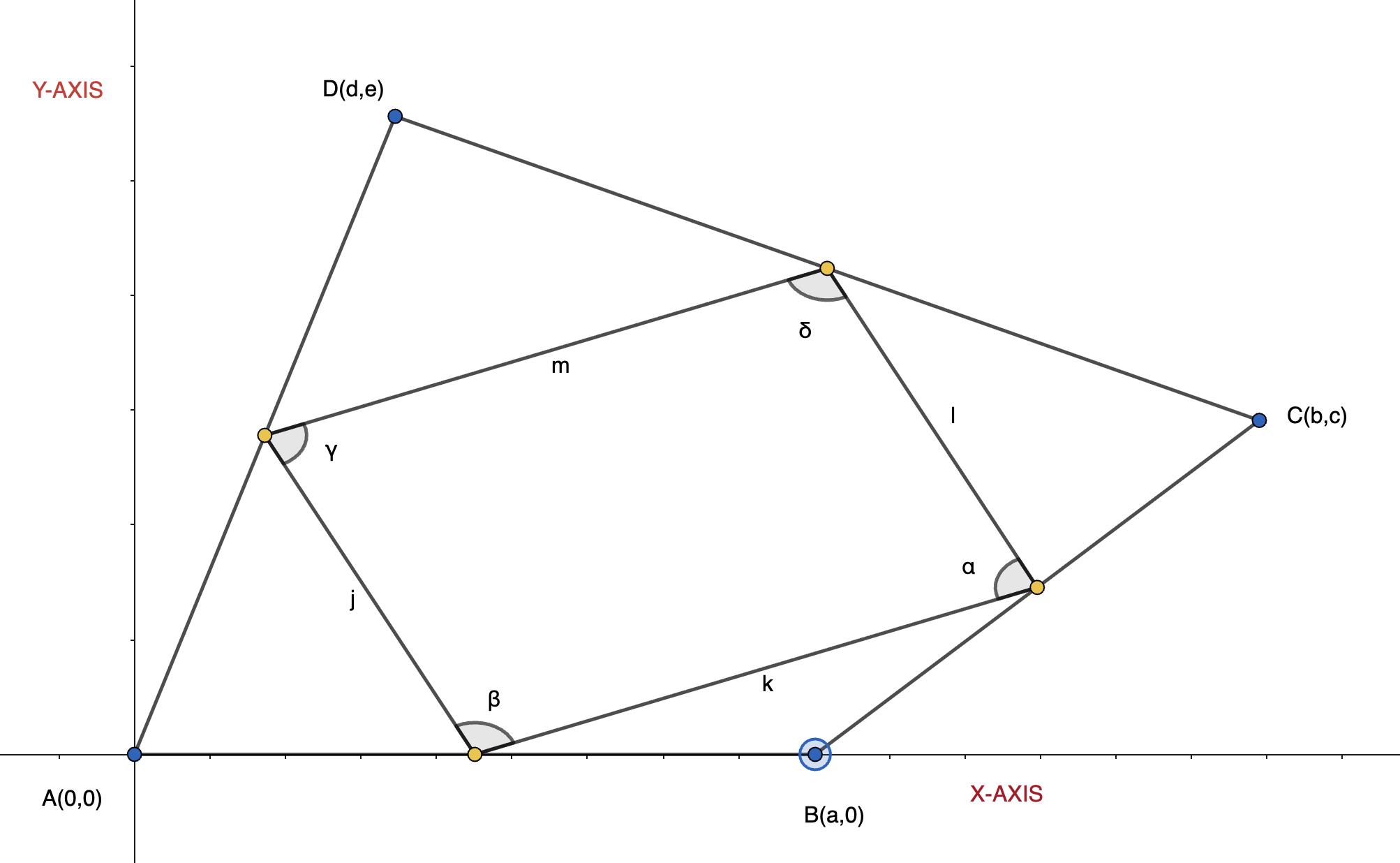
Proof. Place \(A\) at the origin and \(B\) on the positive \(x\)-axis, so that \(A(0, 0)\), \(B(a, 0)\), \(C(b, c)\) and \(D(d, e)\), as in Figure 1. Any quadrilateral can be moved into this position. By Theorem 1.2, the midpoints of \(AB\), \(BC\), \(CD\) and \(DA\) are
Compare opposite sides of \(KLMN\) by their changes in \(x\) and \(y\):
Each pair of opposite sides has the same change in \(x\) and the same change in \(y\). By Theorem 1.1, opposite sides therefore have equal length: \(k = m = \frac 12\sqrt {b^2 + c^2}\) and \(j = l = \frac 12\sqrt {(d - a)^2 + e^2}\). They are also parallel, since they have equal slopes or are both vertical. A quadrilateral whose opposite sides are parallel is a parallelogram.
Remark 1.4. The proof shows more. \(KL\) and \(NM\) both have the same changes as \(\frac 12 \overrightarrow {AC} = (\frac b2, \frac c2)\), so each is parallel to the diagonal \(AC\) and half its length. Likewise \(KN\) and \(LM\) are parallel to \(BD\) and half its length.
Exercise 1.5. Let \(M\) be the midpoint of the side \(AB\) of the parallelogram \(ABCD\). Prove that the segment \(MC\) and the diagonal \(BD\) trisect each other.
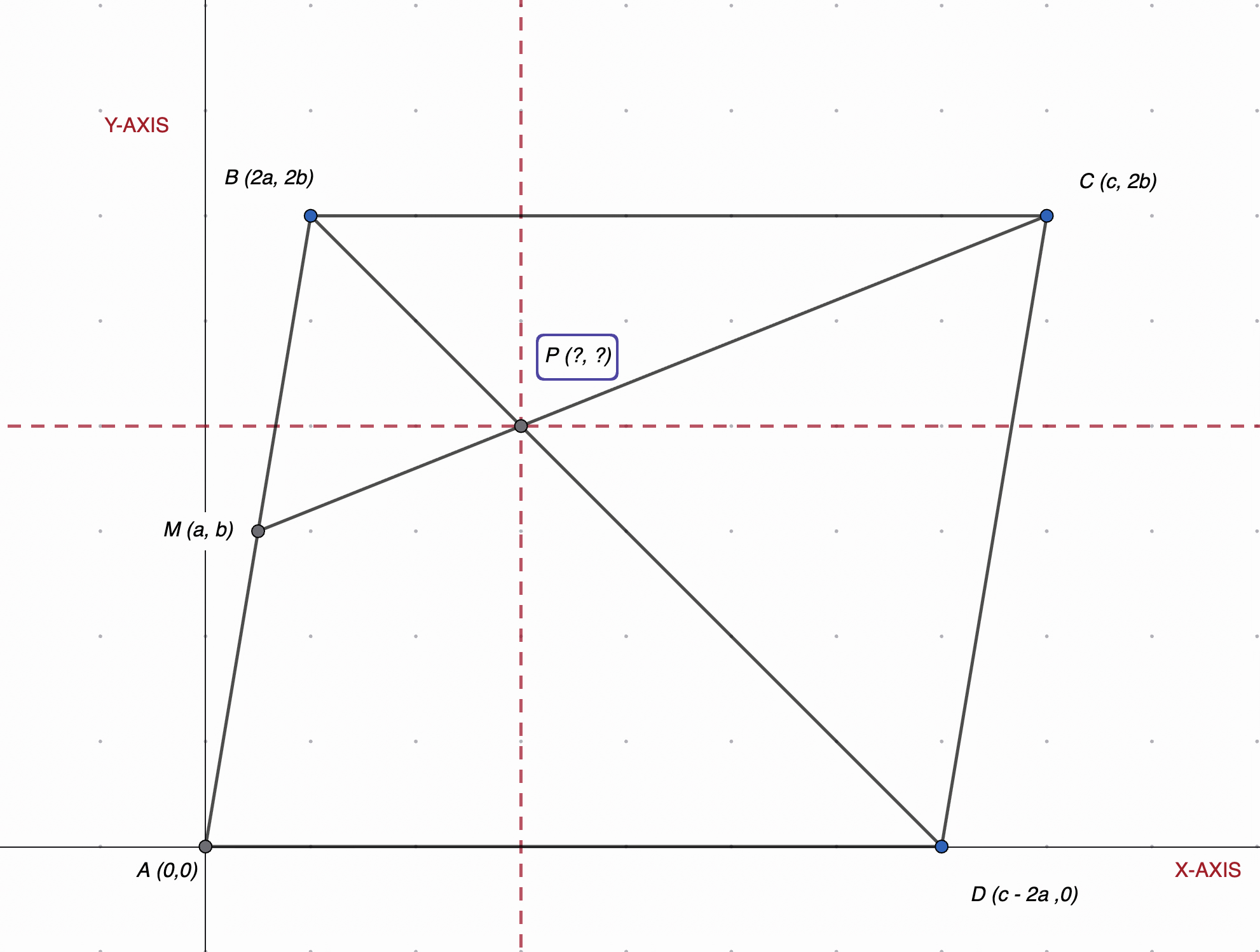
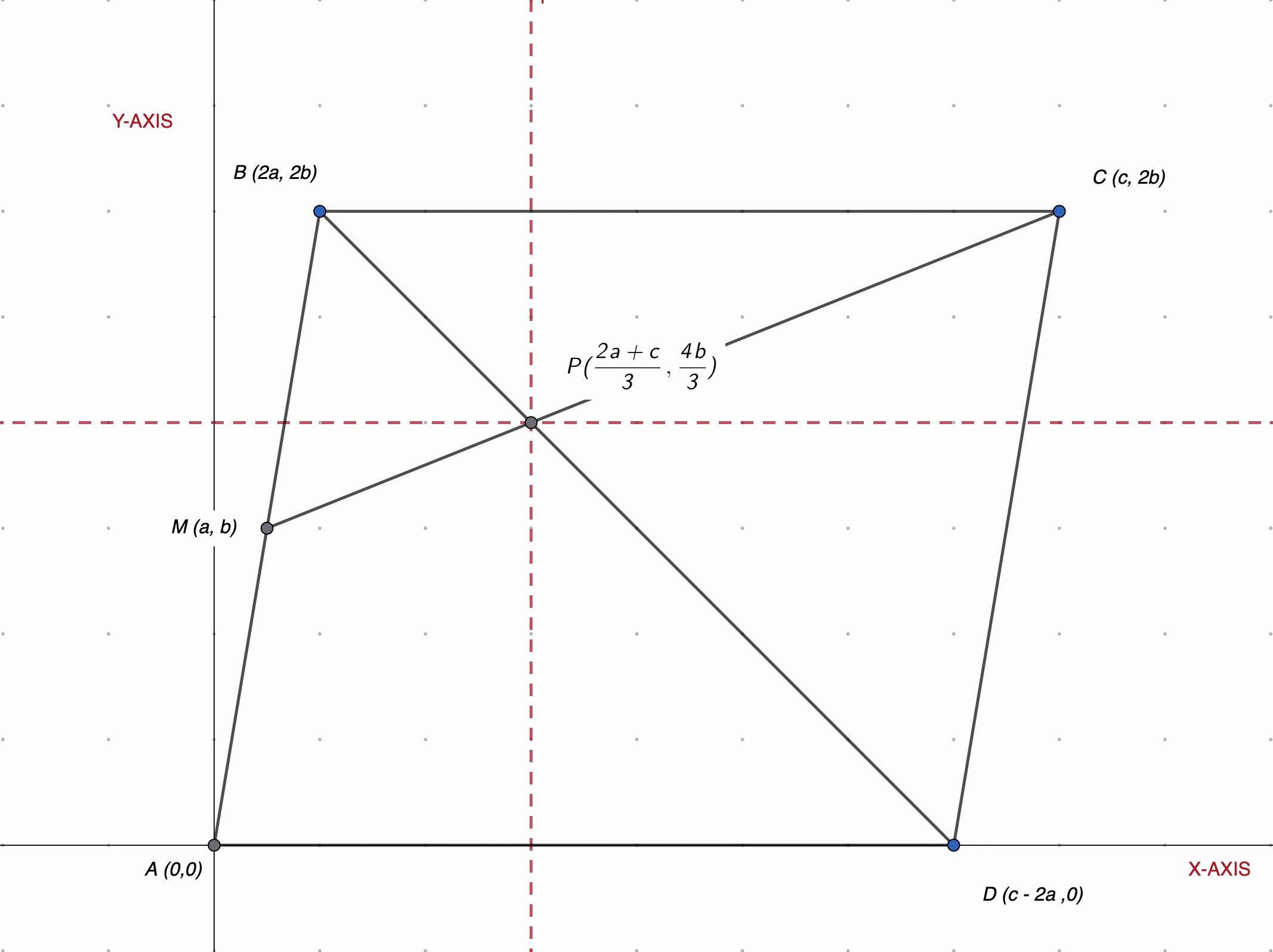
Proof. Place the parallelogram as in Figure 2: \(A(0, 0)\), \(B(2a, 2b)\), \(D(c - 2a, 0)\) and \(C(c, 2b)\), with \(b > 0\) and \(c \neq 2a\). Then \(\overrightarrow {AB} = \overrightarrow {DC}\), so \(ABCD\) really is a parallelogram. The factors of \(2\) make the midpoint \(M(a, b)\) free of fractions.
Finding \(P\). Suppose first that \(c \neq a\) and \(c \neq 4a\), so neither line is vertical. Then
Set them equal, divide by \(b\), and rearrange:
Multiplying by \((c - a)(4a - c)\) gives
which expands to
So \(3(2a - c)\,x = 4a^2 - c^2 = (2a - c)(2a + c)\). Since \(c \neq 2a\),
Then \(x - a = \frac {c - a}{3}\), and the equation of \(MC\) gives
So the lines meet at \(P\bigl ( \frac {2a + c}{3}, \frac {4b}{3} \bigr )\).
Ratios. Neither segment is horizontal, so by Theorem 1.2(b) lengths along each one are in the same ratio as the changes in \(y\). Along \(BD\), the \(y\)-coordinates of \(B\), \(P\), \(D\) are \(2b\), \(\frac {4b}{3}\), \(0\), so
Along \(MC\), the \(y\)-coordinates of \(M\), \(P\), \(C\) are \(b\), \(\frac {4b}{3}\), \(2b\), so
So \(P\) is a point of trisection of both segments: each segment cuts the other one-third of the way along.
Remark 1.6. Theorem 1.2(a) gives a shorter proof that also covers the cases \(c = a\) and \(c = 4a\) excluded above. The point one-third of the way from \(M\) to \(C\) is \(\frac {2M + C}{3} = \bigl ( \frac {2a + c}{3}, \frac {4b}{3} \bigr )\). The point one-third of the way from \(B\) to \(D\) is \(\frac {2B + D}{3} = \bigl ( \frac {2a + c}{3}, \frac {4b}{3} \bigr )\). They are the same point, so the segments meet there and trisect each other. No line equations are needed.
Exercise 1.7. Prove that the segment joining the midpoints of the non-parallel sides of a trapezoid is parallel to the parallel sides, and that its length is half the sum of their lengths.
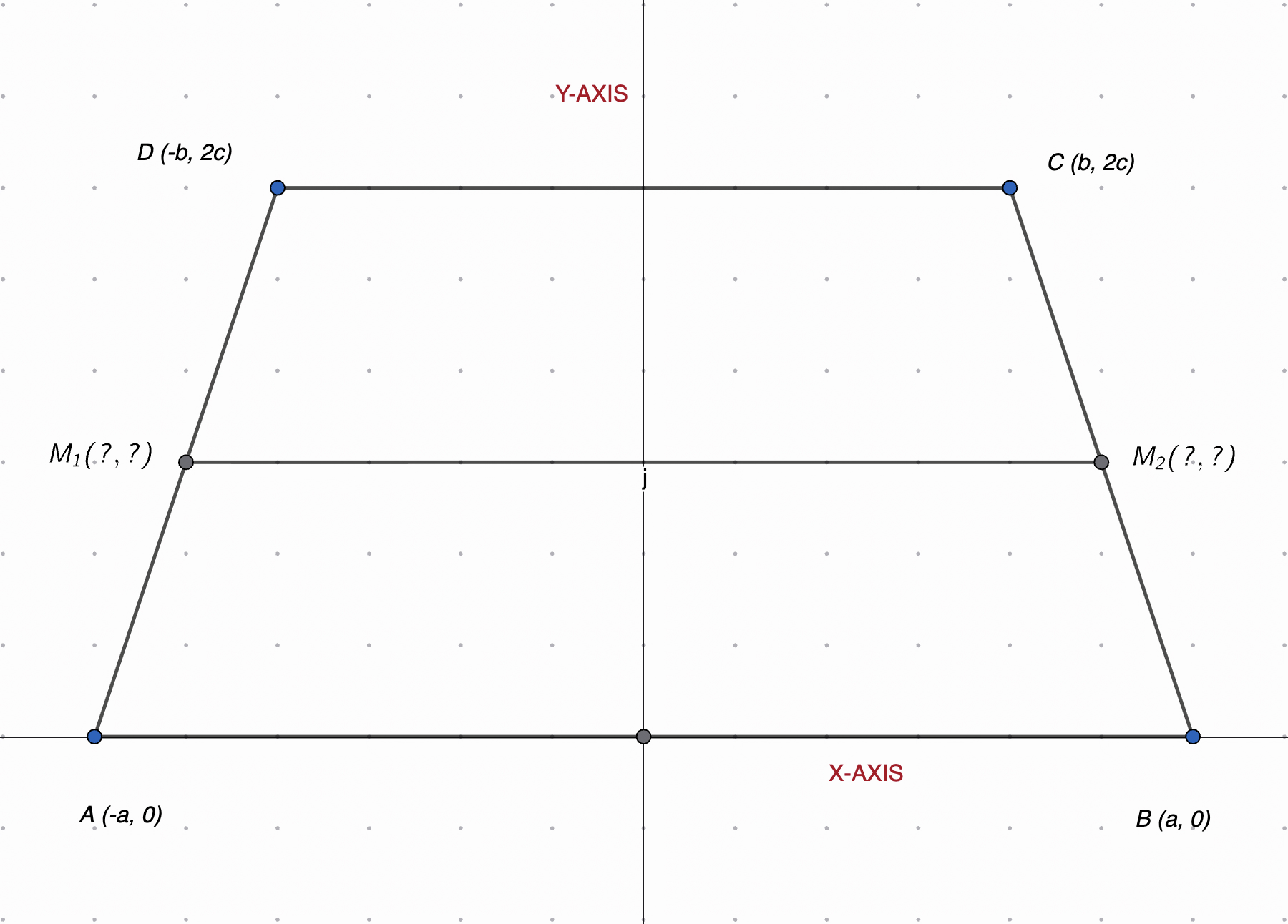
Proof. Put the parallel sides on horizontal lines with \(AB\) centred at the origin: \(A(-a, 0)\), \(B(a, 0)\), \(C(b, 2c)\) and \(D(d, 2c)\), where \(a, c > 0\) and \(d < b\). The non-parallel sides are \(AD\) and \(BC\), and by Theorem 1.2 their midpoints are
Parallel. \(AB\), \(DC\) and \(M_1M_2\) all join two points with equal \(y\)-coordinates, so all three have slope \(0\) and are parallel.
Length. On horizontal segments the length is the change in \(x\):
So \(M_1M_2 = \frac 12 (AB + DC)\).
Remark 1.8. The first version of this proof placed the top side symmetrically, at \(D(-b, 2c)\) and \(C(b, 2c)\) as in Figure 3. That makes the figure symmetric about the \(y\)-axis, so it covers only isosceles trapezoids. Centring one parallel side costs nothing, but the other side must be left free. This is the placement trap described at the start of the chapter.
2 Perpendicular lines
Theorem 2.1 (Perpendicular lines). Two non-vertical lines with slopes \(m_1\) and \(m_2\) are perpendicular if and only if \(m_1 m_2 = -1\). A vertical line is perpendicular exactly to the horizontal lines.
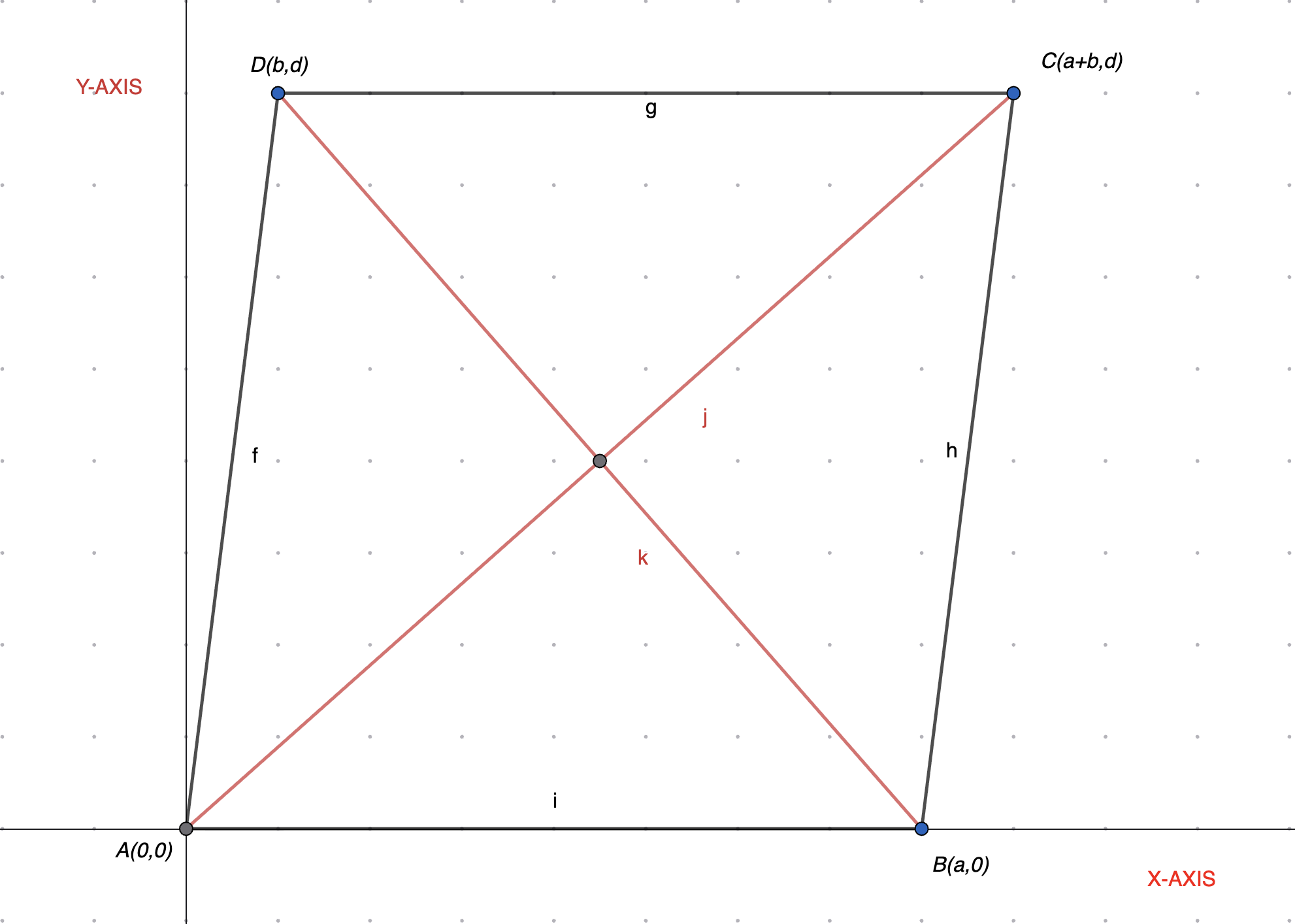
Proof. Place the rhombus as in Figure 4: \(A(0, 0)\), \(B(a, 0)\), \(C(a + b, d)\) and \(D(b, d)\), with \(a > 0\) and \(d \neq 0\). This is a parallelogram, and it is a rhombus when \(AB = AD\), that is,
This gives \(b^2 - a^2 = -d^2 \neq 0\), so \(b \neq \pm a\) and neither diagonal is vertical. Their slopes are
and
By Theorem 2.1, the diagonals are perpendicular.
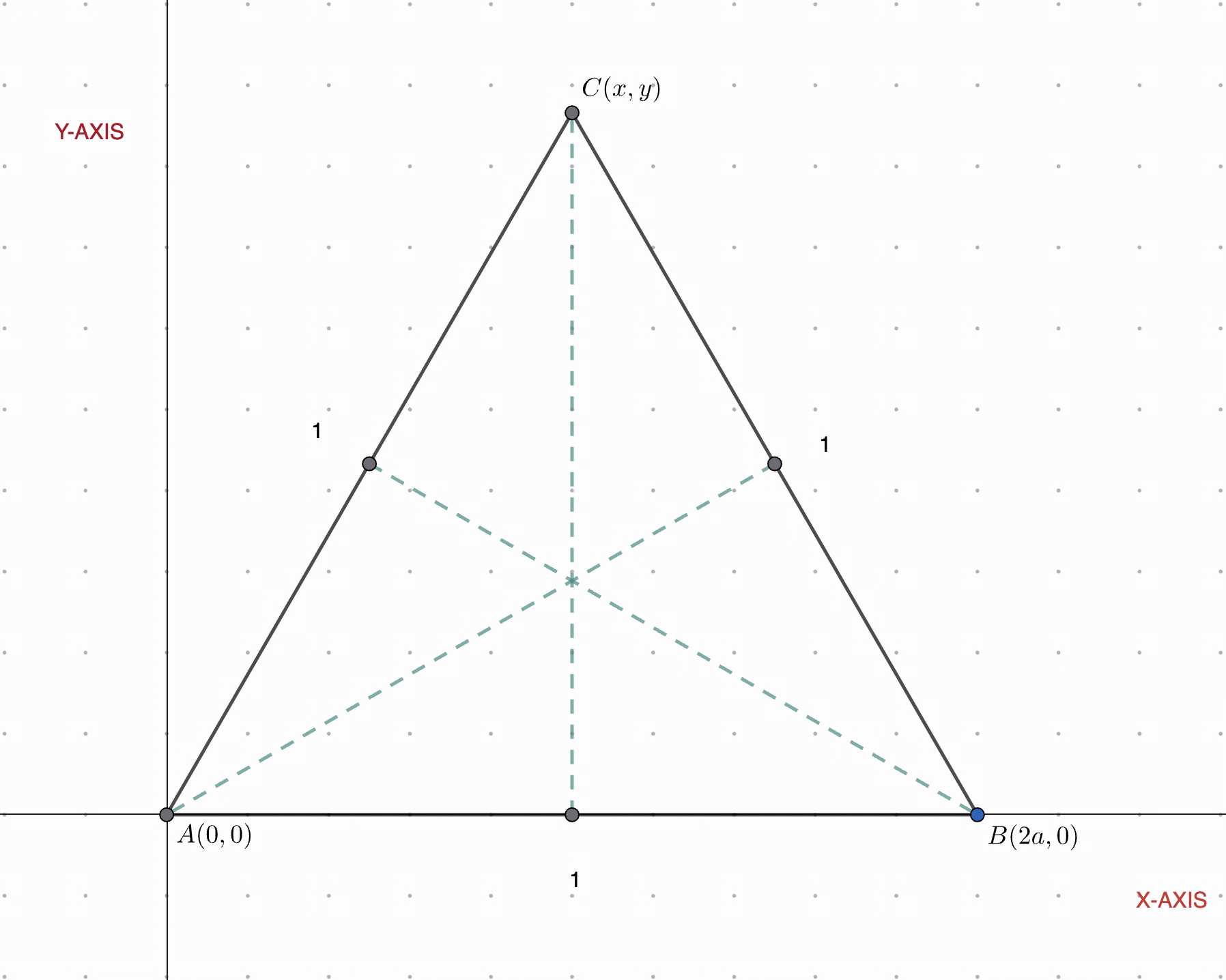
Proof. Let \(A(0, 0)\), \(B(2a, 0)\) with \(a > 0\), and \(C(x, y)\) with \(y > 0\), as in Figure 5.
Locating \(C\). The triangle is equilateral, so \(CA^2 = AB^2 = 4a^2\) and \(CB^2 = AB^2 = 4a^2\). By Theorem 1.1,
Subtracting the first equation from the second gives \(-4ax + 4a^2 = 0\), so \(x = a\). Then \(y^2 = 3a^2\), and since \(y > 0\), \(C = (a, a\sqrt 3)\).
Midpoints. By Theorem 1.2,
Median from \(C\). \(C\) and \(M_{AB}\) both have \(x\)-coordinate \(a\), so this median is the vertical line \(x = a\). It is perpendicular to the horizontal side \(AB\).
Median from \(B\). The slopes are
whose product is \(-1\).
Median from \(A\). The slopes are
whose product is again \(-1\).
By Theorem 2.1, each median is perpendicular to the side it meets, so each median is an altitude.
Exercise 2.4 (Converse of Pythagoras). Prove that if the squares of two sides of a triangle add up to the square of the third side, then the triangle is a right triangle.
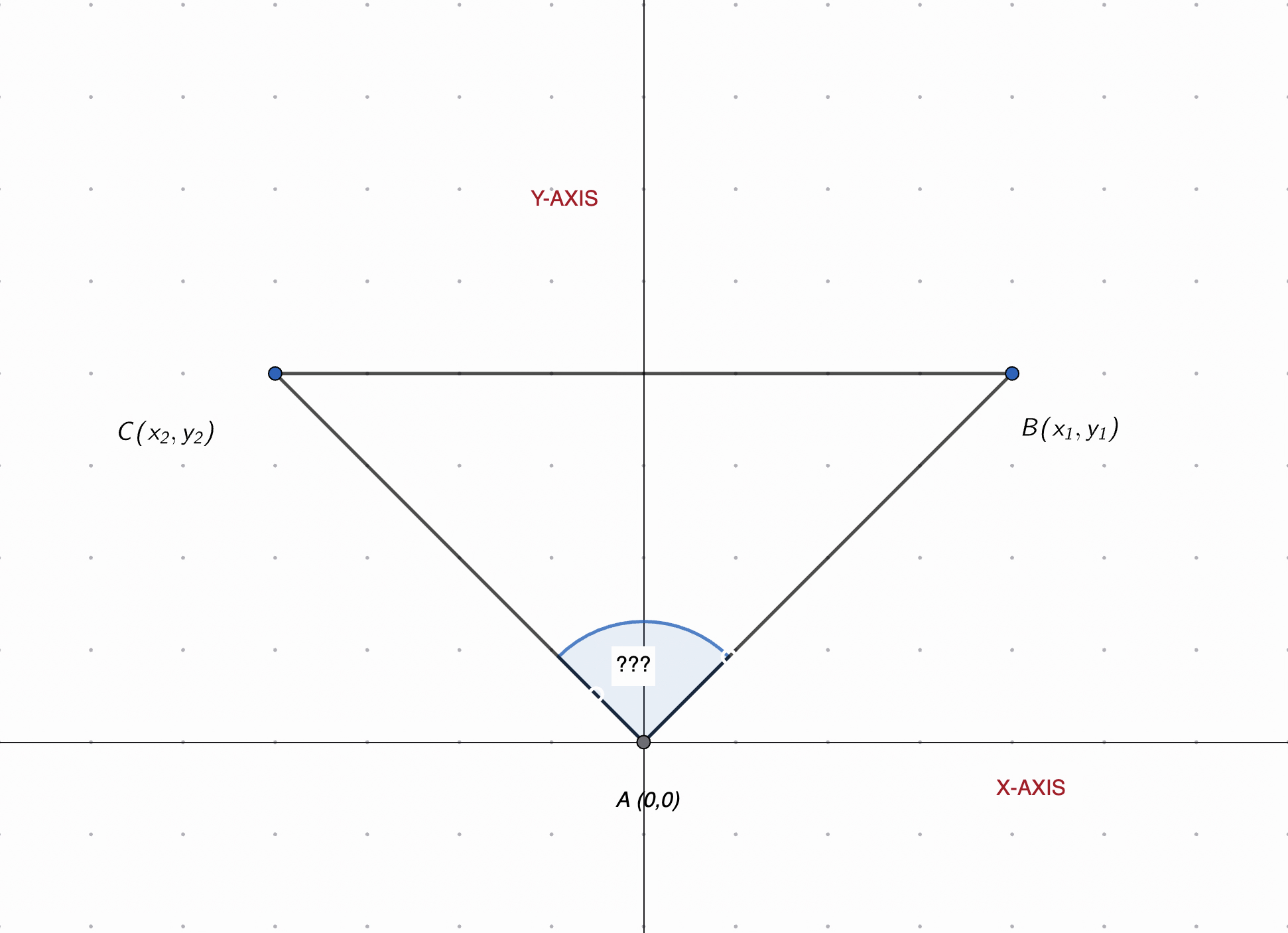
Proof. Name the vertices so that the hypothesis reads \(AB^2 + AC^2 = BC^2\), and put the shared vertex at the origin: \(A(0, 0)\), \(B(x_1, y_1)\) and \(C(x_2, y_2)\). By Theorem 1.1,
Cancelling the common terms leaves
We show that \(AB \perp AC\).
If \(x_1x_2 \neq 0\), neither \(AB\) nor \(AC\) is vertical. Dividing (2.1) by \(x_1x_2\) gives
which is \(m_{AB}\, m_{AC} = -1\). Apply Theorem 2.1.
If \(x_1 = 0\), then \(B \neq A\) forces \(y_1 \neq 0\), and (2.1) becomes \(y_1 y_2 = 0\), so \(y_2 = 0\). Then \(AB\) lies on the \(y\)-axis and \(AC\) on the \(x\)-axis, so they are perpendicular. The case \(x_2 = 0\) is the same with \(B\) and \(C\) exchanged.
In every case the angle at \(A\) is a right angle.
Remark 2.5. The slope argument alone breaks down when a side is vertical, which is why the case split is needed. In vector language, (2.1) says \(\overrightarrow {AB} \cdot \overrightarrow {AC} = 0\), which handles every case at once.
Exercise 2.6. Prove that the perpendicular bisector of a chord of a circle passes through the centre.
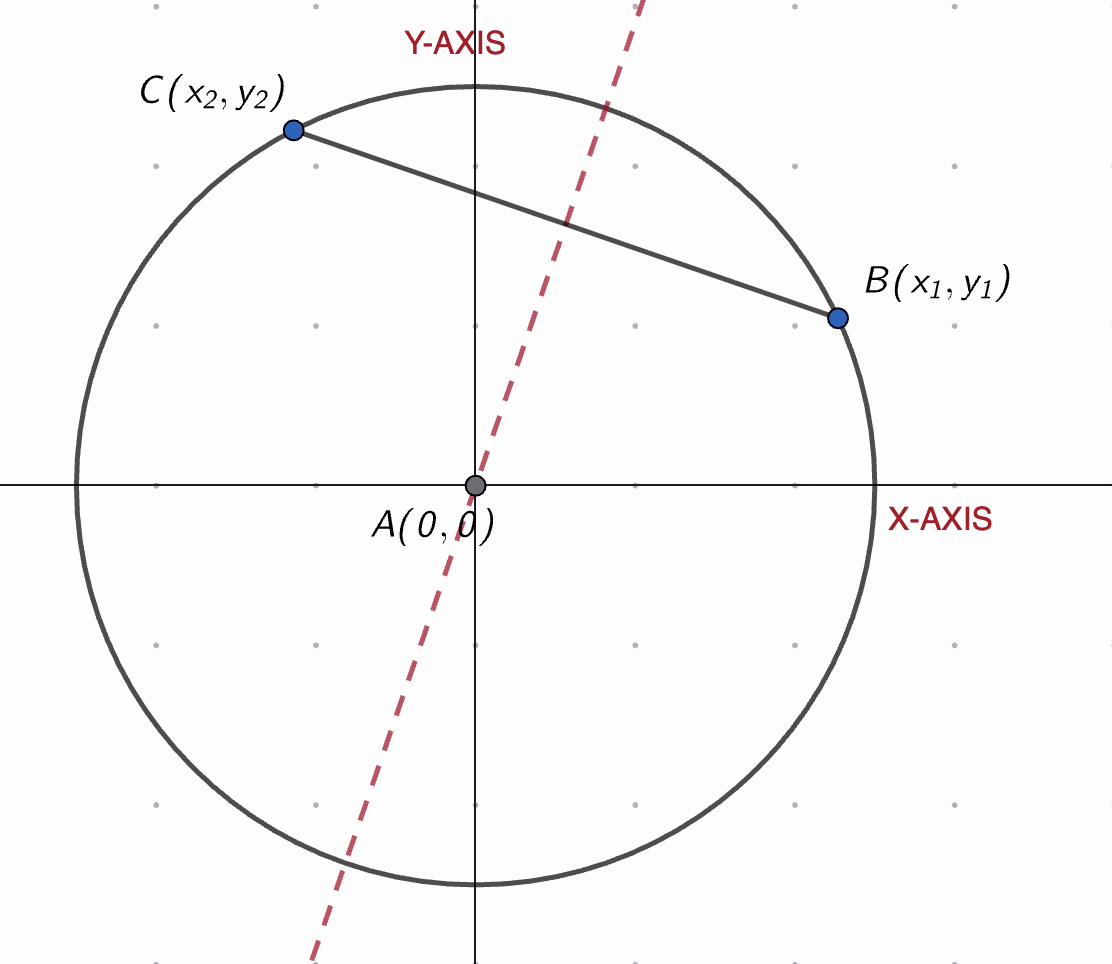
Proof. Centre the circle at the origin \(A(0, 0)\) with radius \(r\), and let the chord have endpoints \(B(x_1, y_1) \neq C(x_2, y_2)\) on the circle, so
The midpoint of \(BC\) is \(M\bigl (\frac {x_1 + x_2}{2}, \frac {y_1 + y_2}{2}\bigr )\).
General case: \(x_1 \neq x_2\) and \(y_1 \neq y_2\). Here \(m_{BC} = \frac {y_2 - y_1}{x_2 - x_1}\) is neither zero nor undefined. By Theorem 2.1, the perpendicular bisector has slope \(-\frac {x_2 - x_1}{y_2 - y_1}\), so its equation is
The origin lies on this line exactly when
Multiplying by \(-2(y_2 - y_1) \neq 0\) turns this into the equivalent condition
This is true by (2.2). So the bisector passes through \(A\).
Horizontal chord: \(y_1 = y_2\). Then \(x_1 \neq x_2\), and (2.2) gives \(x_1^2 = x_2^2\), so \(x_2 = -x_1\). The perpendicular bisector is the vertical line through \(M\), namely \(x = \frac {x_1 + x_2}{2} = 0\). This is the \(y\)-axis, which contains \(A\).
Vertical chord: \(x_1 = x_2\). In the same way \(y_2 = -y_1\), and the bisector is \(y = 0\), which contains \(A\).
Remark 2.7. A slope-free proof is possible. The perpendicular bisector of \(BC\) is exactly the set of points equidistant from \(B\) and \(C\), and the centre is such a point, since \(AB = AC = r\).
Chapter 2: Conics and Their Reflective Properties
Parabolas and ellipses in standard position. The tools are implicit differentiation for tangent slopes and the angle formula for comparing two lines. The chapter ends with the reflective property of the ellipse.
3 The parabola
Theorem 3.1 (Parabola in standard position). The parabola with focus \((h + p, k)\) and directrix \(x = h - p\), where \(p \neq 0\), is
Its vertex is \((h, k)\) and its axis is the line \(y = k\). Exchanging the roles of \(x\) and \(y\) gives the parabola \((x - h)^2 = 4p(y - k)\) with a vertical axis.
Exercise 3.2. Tangent lines \(T_1\) and \(T_2\) to the parabola \(y = x^2\) at the points \(P_1\) and \(P_2\) meet at \(P\). A third tangent \(T\), touching the parabola at a point between \(P_1\) and \(P_2\), meets \(T_1\) at \(Q_1\) and \(T_2\) at \(Q_2\). Show that
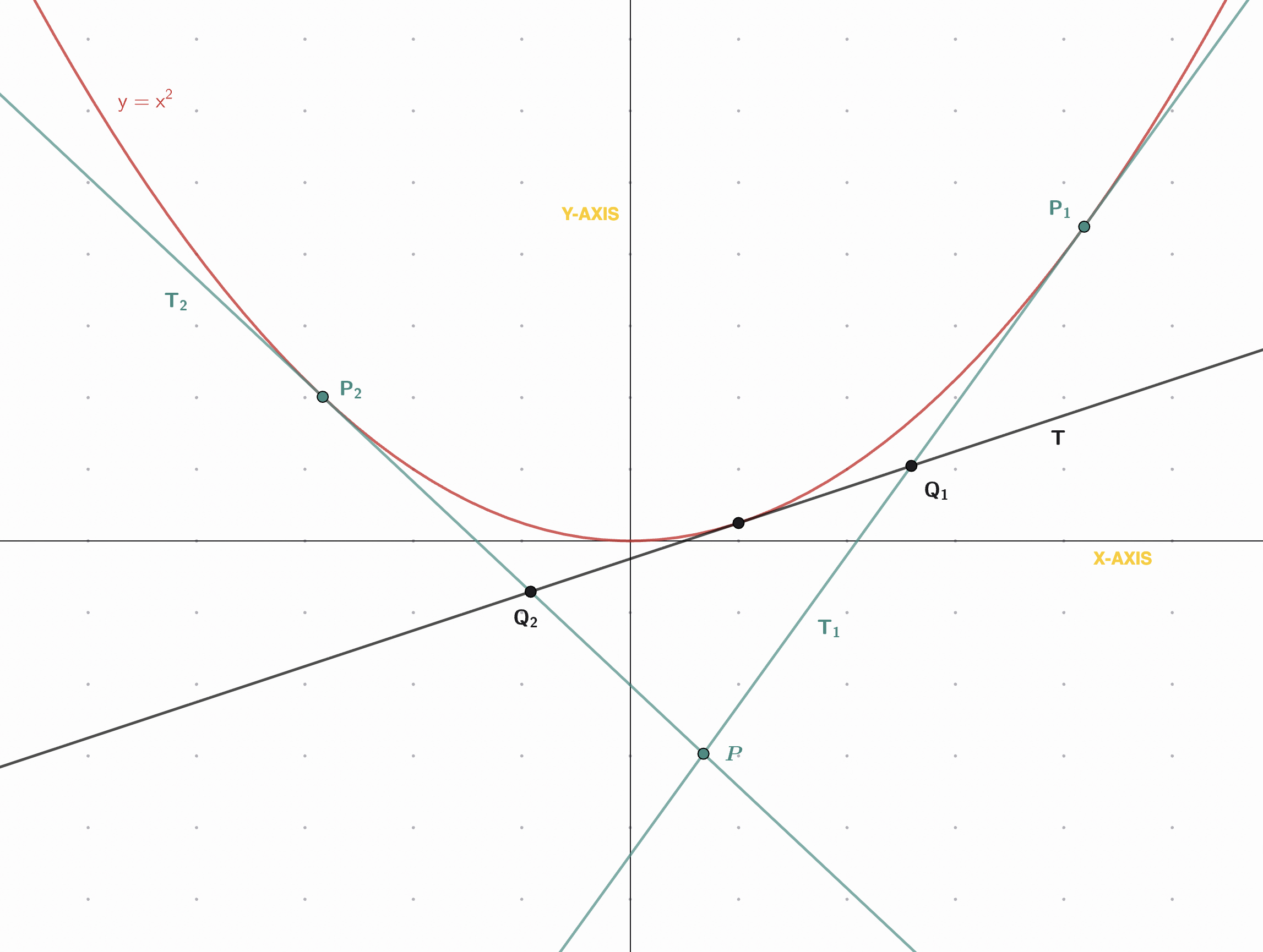
Solution. Let \(P_1 = (a, a^2)\) and \(P_2 = (b, b^2)\), and let \(T\) touch at \((c, c^2)\) with \(c\) strictly between \(a\) and \(b\). In Figure 8 we have \(b < c < a\), but the argument below does not depend on the order.
Tangents. Since \(\frac {\dd y}{\dd x} = 2x\), the tangent at \((s, s^2)\) is \(y - s^2 = 2s(x - s)\), that is, \(y = 2sx - s^2\). So
Intersections. Tangents at \(s \neq u\) meet where \(2(s - u)\,x = s^2 - u^2\), that is, at \(x = \frac {s + u}{2}\), and then \(y = 2s \cdot \frac {s + u}{2} - s^2 = su\). Hence
Ratios. The points \(P\), \(Q_1\), \(P_1\) lie on \(T_1\), which is not vertical. By Theorem 1.2(b), the ratio of lengths equals the ratio of changes in \(x\):
In the same way, on \(T_2\),
Because \(c\) lies between \(a\) and \(b\), \(\abs {b - c} + \abs {c - a} = \abs {b - a}\), and so
Remark 3.3. The intersection rule is worth remembering: the tangents at \(s\) and \(u\) meet at \(\bigl (\frac {s + u}{2}, su\bigr )\), above the midpoint of \(s\) and \(u\).
Exercise 3.4. Let \(P(x_1, y_1)\) be a point other than the vertex on the parabola \(y^2 = 2px\). Find the normal line at \(P\), and show that it meets the \(x\)-axis at \(Q(x_1 + p, 0)\).
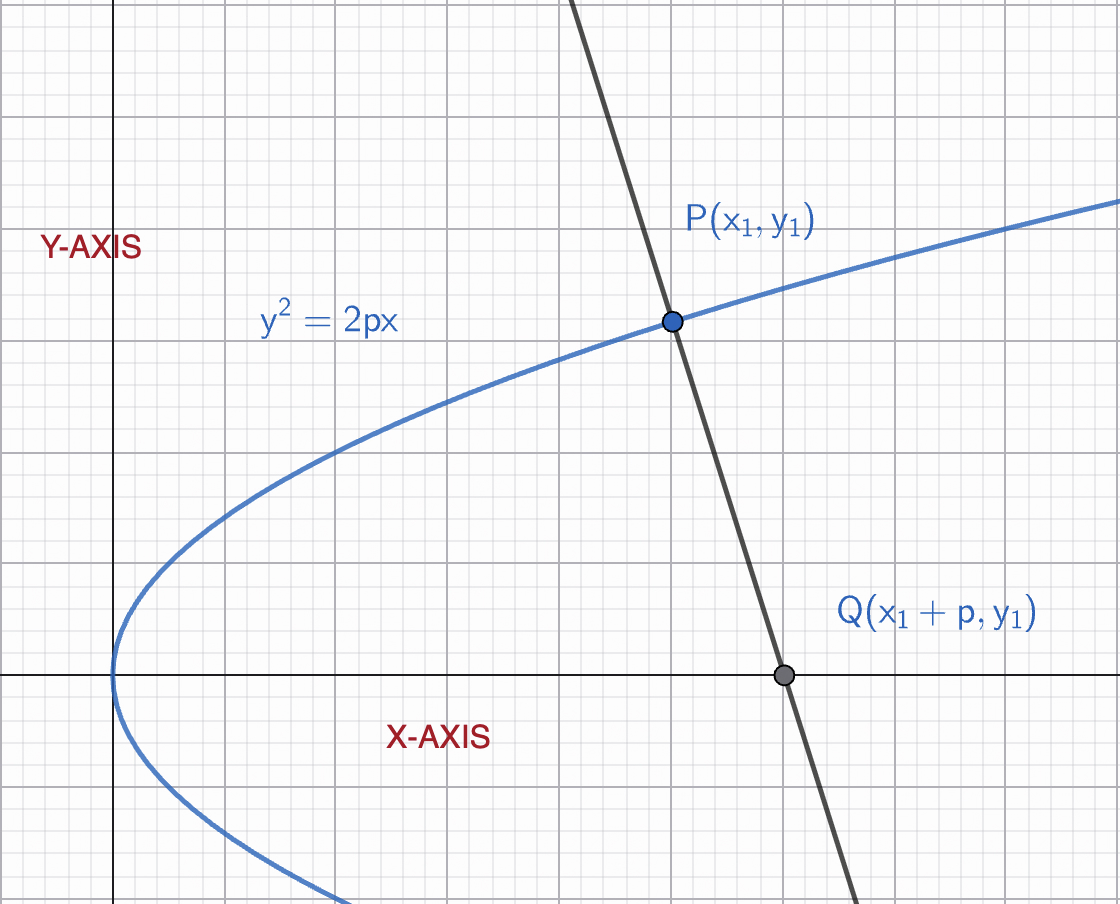
Solution. Differentiating \(y^2 = 2px\) implicitly gives \(2y\,\frac {\dd y}{\dd x} = 2p\), so the tangent at \(P\) has slope \(p / y_1\). Here \(y_1 \neq 0\) because \(P\) is not the vertex. By Theorem 2.1, the normal has slope \(-y_1 / p\), and its equation is
At the \(x\)-axis \(y = 0\), so \(-y_1 = -\frac {y_1}{p}(x - x_1)\). Dividing by \(-y_1 \neq 0\) gives \(1 = \frac {x - x_1}{p}\), that is, \(x = x_1 + p\). So the normal meets the axis at \(Q(x_1 + p, 0)\). \(\relax \vartriangleleft \)
Remark 3.5. This is the reflective property of the parabola in disguise. Writing \(y^2 = 2px\) as \(y^2 = 4 \cdot \frac p2 \cdot x\), Theorem 3.1 puts the focus at \(F(\frac p2, 0)\) and the directrix at \(x = -\frac p2\). By the focus–directrix definition, \(FP = x_1 + \frac p2 = FQ\), so the triangle \(FPQ\) is isosceles. The normal \(PQ\) therefore makes equal angles with \(PF\) and with the horizontal line through \(P\). In other words, rays parallel to the axis reflect through the focus.
4 The ellipse
Theorem 4.1 (Ellipse in standard position). Let \(0 \leq c < a\) and \(b^2 = a^2 - c^2\). The set of points whose distances to the foci \(F_1(-c, 0)\) and \(F_2(c, 0)\) add up to \(2a\) is the ellipse
It meets the \(x\)-axis at \((\pm a, 0)\) and the \(y\)-axis at \((0, \pm b)\).
Exercise 4.2. A highway overpass has the shape of half an ellipse, with a base 200 feet wide. The highway beneath it is 120 feet wide, and the minimum clearance over the highway is 40 feet. Find the height of the overpass at its centre.
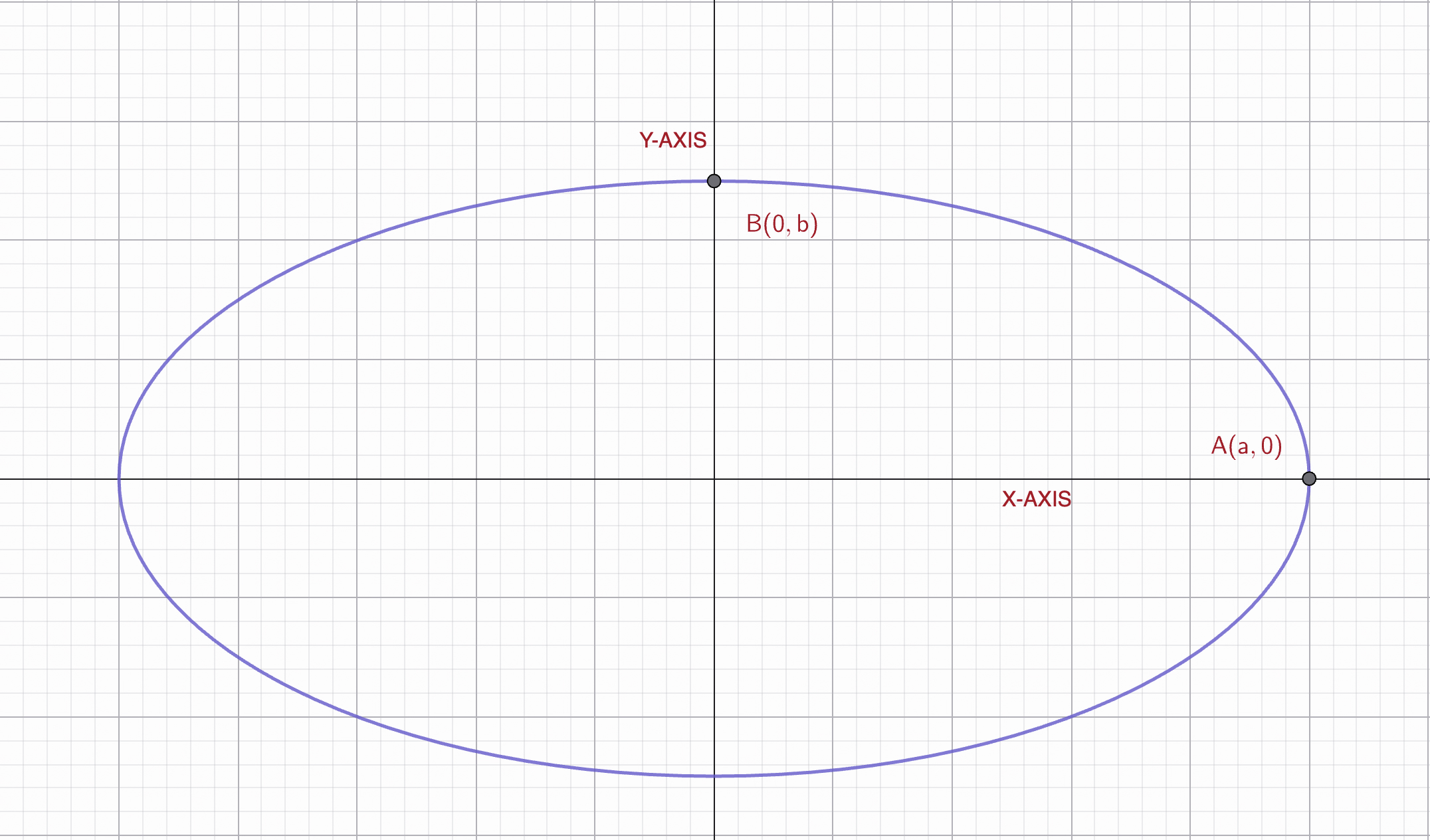
Solution. Put the centre of the base at the origin, so the arch is the upper half of \(\frac {x^2}{a^2} + \frac {y^2}{b^2} = 1\) and the height at the centre is \(b\).
Base. The base is the major axis, so \(2a = 200\) and \(a = 100\).
Clearance. The highway runs from \(x = -60\) to \(x = 60\). On the upper half, \(y\) decreases as \(\abs {x}\) grows, so the clearance over the road is smallest at its edges. Therefore \((60, 40)\) lies on the ellipse:
Since \(b > 0\), \(b = 50\). The overpass is \(50\) feet high at its centre. \(\relax \vartriangleleft \)
5 Reflection
Theorem 5.1 (Angle between two lines). Let \(l_1\) and \(l_2\) be non-perpendicular lines with slopes \(m_1\) and \(m_2\), and let \(\alpha \) be the angle from \(l_1\) to \(l_2\) (measured anticlockwise). Then
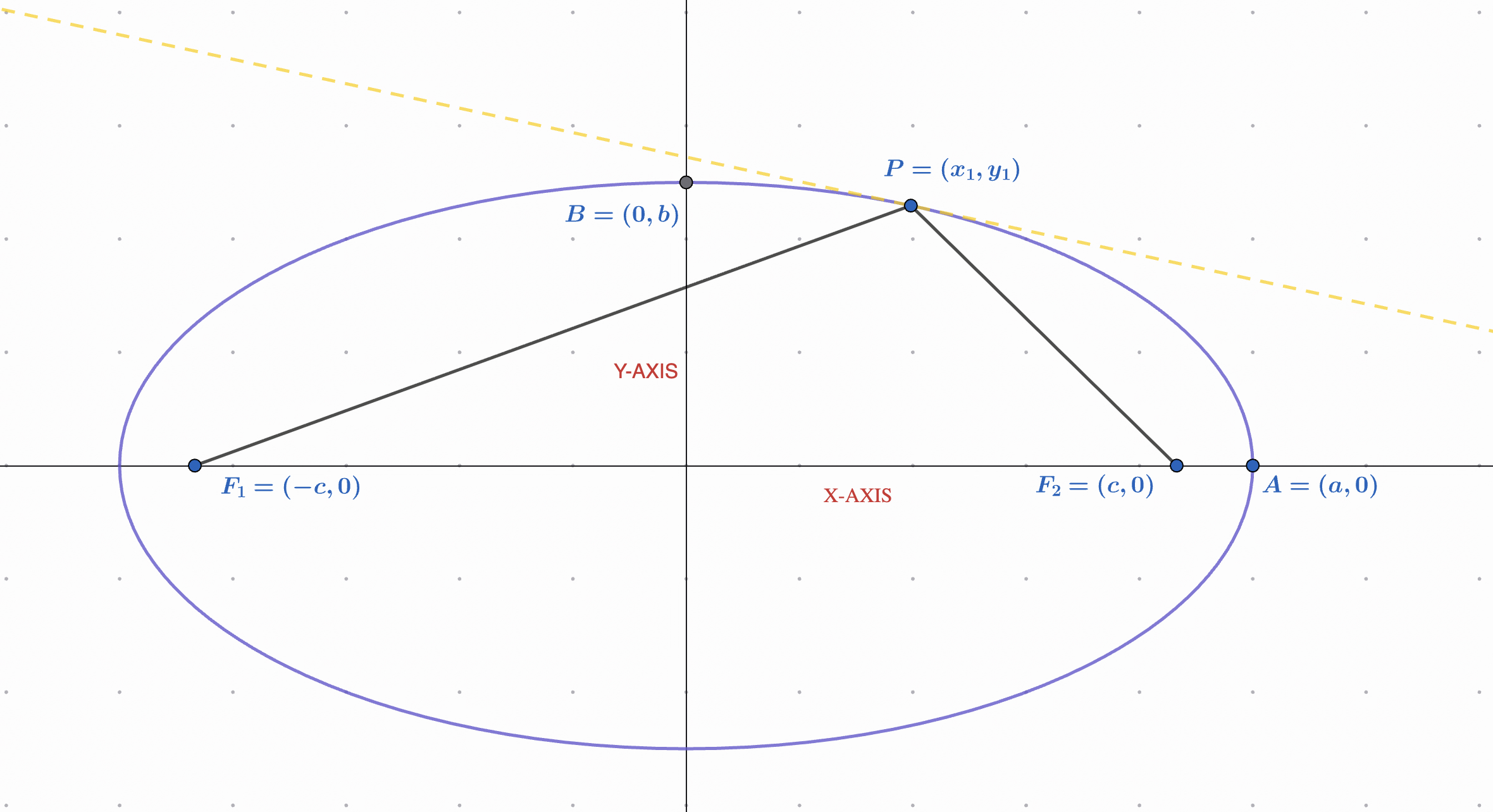
Theorem 5.2 (Reflective property of the ellipse). A ray leaving one focus of an ellipse is reflected by the ellipse through the other focus.
Proof. Take the ellipse of Theorem 4.1 with \(c > 0\) (if \(c = 0\) it is a circle, and every ray from the centre returns along itself). Let \(P(x_1, y_1)\) be on the ellipse.
If \(y_1 = 0\), then \(P = (\pm a, 0)\), the tangent there is vertical, and the ray runs along the \(x\)-axis, so it returns along the axis through both foci. Suppose now \(y_1 \neq 0\) and, for the moment, \(x_1 \neq \pm c\), so that neither focal line is vertical.
Slopes. Differentiating \(x^2/a^2 + y^2/b^2 = 1\) implicitly gives \(2x/a^2 + (2y/b^2)\,y' = 0\). So the tangent at \(P\) has slope
and the lines \(F_1P\) and \(F_2P\) have slopes
Below we use \(b^2 x_1^2 + a^2 y_1^2 = a^2 b^2\) (because \(P\) is on the ellipse) and \(a^2 - b^2 = c^2\).
Incoming angle. Let \(\alpha \) be the angle from \(F_1P\) to the tangent. By Theorem 5.1, \(\tan \alpha = (m - m_1)/(1 + m m_1)\). Multiply the numerator and the denominator by \(a^2 y_1 (x_1 + c)\):
Since \(\abs {x_1} \leq a\) and \(c < a\), we have \(a^2 + c x_1 > 0\). So the denominator is not zero (the lines are not perpendicular), and
Outgoing angle. Let \(\beta \) be the angle from the tangent to \(F_2P\), so \(\tan \beta = (m_2 - m)/(1 + m m_2)\). Multiply the numerator and the denominator by \(a^2 y_1 (x_1 - c)\):
with \(a^2 - c x_1 > 0\). Hence
Both angles lie in \([0, \pi )\), where \(\tan \) is one-to-one, so \(\alpha = \beta \). So \(F_1P\) and \(F_2P\) make equal angles with the tangent, one on each side: reflecting the line \(F_1P\) in the tangent gives the line \(F_2P\). This is the law of reflection (the angle of incidence equals the angle of reflection), so the reflected ray passes through \(F_2\).
When \(x_1 = \pm c\), one focal line is vertical and the slope formula does not apply. The result still holds there by continuity: both angles depend continuously on \(P\), and they agree at every nearby point of the ellipse.
Remark 5.3. The simplifications in the proof rely on two facts: \(P\) lies on the ellipse, so \(b^2x_1^2 + a^2y_1^2 = a^2b^2\), and \(a^2 - b^2 = c^2\). Without substituting both, the expressions for \(\tan \alpha \) and \(\tan \beta \) do not visibly agree.
Chapter 3: Rotation of Axes
A second-degree equation with an \(xy\) term describes a conic whose axes are tilted. Rotating the coordinate axes through the right angle removes that term, and completing the square then puts the conic in standard position. The same formulas run backwards to take a conic from standard position to a tilted one.
6 Removing the cross term
Theorem 6.1 (Rotation of axes). Rotating the axes through an angle \(\theta \) gives new coordinates \((x', y')\) related to the old ones by
If \(B \neq 0\), the rotation with
removes the cross term from \(Ax^2 + Bxy + Cy^2 + Dx + Ey + F = 0\). In particular \(\theta = \pi /4\) when \(A = C\).
Proof. The two systems are inverse to each other, since the matrix of a rotation by \(\theta \) has inverse the rotation by \(-\theta \). Substitute the left-hand formulas into the quadratic part. Only \(x^2\), \(xy\) and \(y^2\) produce an \(x'y'\) term, and its coefficient is
This vanishes exactly when \(\cot 2\theta = (A - C)/B\), and \(\cot \) takes every real value once on \((0, \pi )\).
Exercise 6.2. Rotate the axes to remove the cross term from
and find a standard equation for the curve in the rotated \(x''y''\)-coordinates.
Solution. Here \(A = 1\), \(B = -2\) and \(C = 1\). Since \(A = C\), Theorem 6.1 gives \(\theta = \frac {\pi }{4}\), with \(\cos \theta = \sin \theta = \frac {1}{\sqrt 2}\):
The first three terms form a perfect square, so the equation is \((x' - y')^2 - 2y' = 0\). Now
so the equation becomes
Complete the square by adding \(\bigl (\frac {\sqrt 2}{4}\bigr )^2 = \frac 18\) to both sides:
using \(\frac 18 \cdot \frac {2}{\sqrt 2} = \frac {1}{4\sqrt 2} = \frac {\sqrt 2}{8}\). By Theorem 3.1, this is a parabola with horizontal axis \(y'' = \frac {\sqrt 2}{4}\) and vertex \(\bigl (-\frac {\sqrt 2}{8}, \frac {\sqrt 2}{4}\bigr )\). Since \(4p = \frac {\sqrt 2}{2}\), we have \(p = \frac {\sqrt 2}{8}\). \(\relax \vartriangleleft \)
7 Rotating back
Exercise 7.1. An ellipse has foci \(A(-12, -5)\) and \(B(12, 5)\) and passes through \(P_1(-2.5, 6)\). In coordinates whose \(x'\)-axis contains the foci, its equation is
Find its equation in the original \(xy\)-coordinates.
Solution. Angle. The \(x'\)-axis is the line through the origin and the foci. Its slope is \(\frac {5 - (-5)}{12 - (-12)} = \frac {5}{12}\), so \(\tan \theta = \frac {5}{12}\). With hypotenuse \(\sqrt {5^2 + 12^2} = 13\), this gives \(\sin \theta = \frac {5}{13}\) and \(\cos \theta = \frac {12}{13}\).
Substitution. By Theorem 6.1,
Multiplying the equation by \(845 = 5 \cdot 169\) gives \(4x'^2 + 20y'^2 = 845\). Substituting,
Multiply by \(169\) (note \(845 \cdot 169 = 142805\)) and expand:
The ellipse is
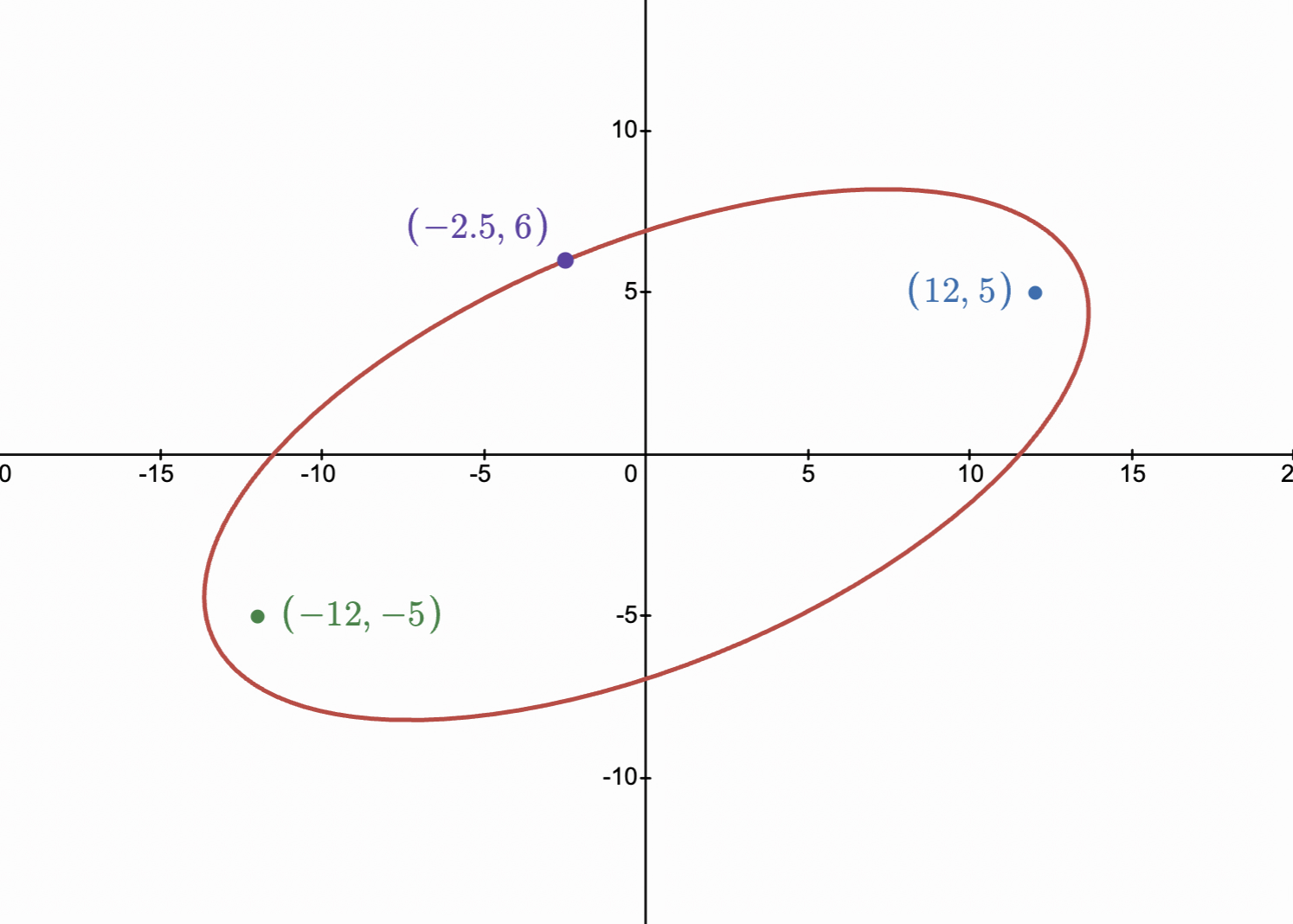
Remark 7.2. Three checks, all by hand.
- The given point. At \(P_1(-2.5, 6)\), \(x' = \frac {-30 + 30}{13} = 0\) and \(y' = \frac {12.5 + 72}{13} = 6.5\), so \(4x'^2 + 20y'^2 = 20 \cdot 42.25 = 845\). In the final equation, \(1076(6.25) + 1920(15) + 2980(36) = 6725 + 28800 + 107280 = 142805\).
- The foci. In the \(x'y'\) form, \(a^2 = \frac {845}{4}\) and \(b^2 = \frac {169}{4}\), so \(c^2 = a^2 - b^2 = 169\) and \(c = 13\). This is the distance from the origin to \((12, 5)\), as it should be.
- The picture. Figure 12 plots the result.
Chapter 4: Parametric Curves
A parametric curve gives \(x\) and \(y\) separately as functions of a parameter \(t\). This records not just the set of points but the way the curve is traced: where it starts, which way it goes and how often it passes each point. Circles are the basic building block. The chapter ends with the geometry behind the rotary engine.
8 Circles and arcs
Theorem 8.1 (Parametric circle). For \(0 \leq t \leq 1\),
traces the circle with centre \((h, k)\) and radius \(r\) exactly once, anticlockwise, starting and ending at \((h + r, k)\). Replacing \(2\pi t\) by \(\theta _0 + (\theta _1 - \theta _0)t\) traces only the arc from angle \(\theta _0\) to angle \(\theta _1\).
Exercise 8.2. Find parametric equations, with \(0 \leq t \leq 1\), for a particle that moves along \(y = x^2\) from \((1, 1)\) to \((-1, 1)\) and back to \((1, 1)\).
Then \(y = x^2\) for every \(t\), so the particle stays on the parabola. As \(t\) runs over \([0, \frac 12]\), \(2\pi t\) runs over \([0, \pi ]\) and \(x = \cos 2\pi t\) decreases from \(1\) to \(-1\). As \(t\) runs over \([\frac 12, 1]\), \(x\) increases back to \(1\). So the particle goes from \((1, 1)\) to \((-1, 1)\) and returns, passing through each point of the arc once in each direction. \(\relax \vartriangleleft \)
Exercise 8.3. Find parametric equations, with \(0 \leq t \leq 1\) (several sets are needed), that draw the face in Figure 13.
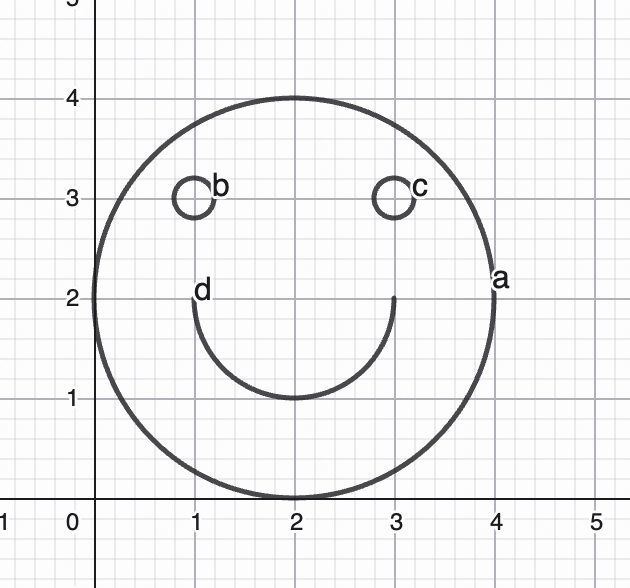
Solution. All four pieces come from Theorem 8.1.
- (a)
- Face, centre \((2, 2)\) and radius \(2\): \(x = 2 + 2\cos 2\pi t\), \(y = 2 + 2\sin 2\pi t\).
- (b)
- Left eye, centre \((1, 3)\) and radius \(0.2\): \(x = 1 + 0.2\cos 2\pi t\), \(y = 3 + 0.2\sin 2\pi t\).
- (c)
- Right eye, centre \((3, 3)\) and radius \(0.2\): \(x = 3 + 0.2\cos 2\pi t\), \(y = 3 + 0.2\sin 2\pi t\).
- (d)
- Smile, the lower half of the circle with centre \((2, 2)\) and radius \(1\), so the angles run from \(\pi \) to \(2\pi \): \[ x = 2 + \cos (\pi + \pi t), \qquad y = 2 + \sin (\pi + \pi t). \]
It starts at \((1, 2)\) when \(t = 0\), passes through \((2, 1)\) when \(t = \frac 12\) and ends at \((3, 2)\) when \(t = 1\). \(\relax \vartriangleleft \)
Exercise 8.4. Circles of radius \(a\) and \(b\), with \(a > b > 0\), are centred at the origin. A ray from the origin at angle \(t\) to the positive \(x\)-axis meets the large circle and then the small one. The point \(P\) takes its \(x\)-coordinate from the first intersection and its \(y\)-coordinate from the second. Find parametric equations for the curve traced by \(P\), and identify it.
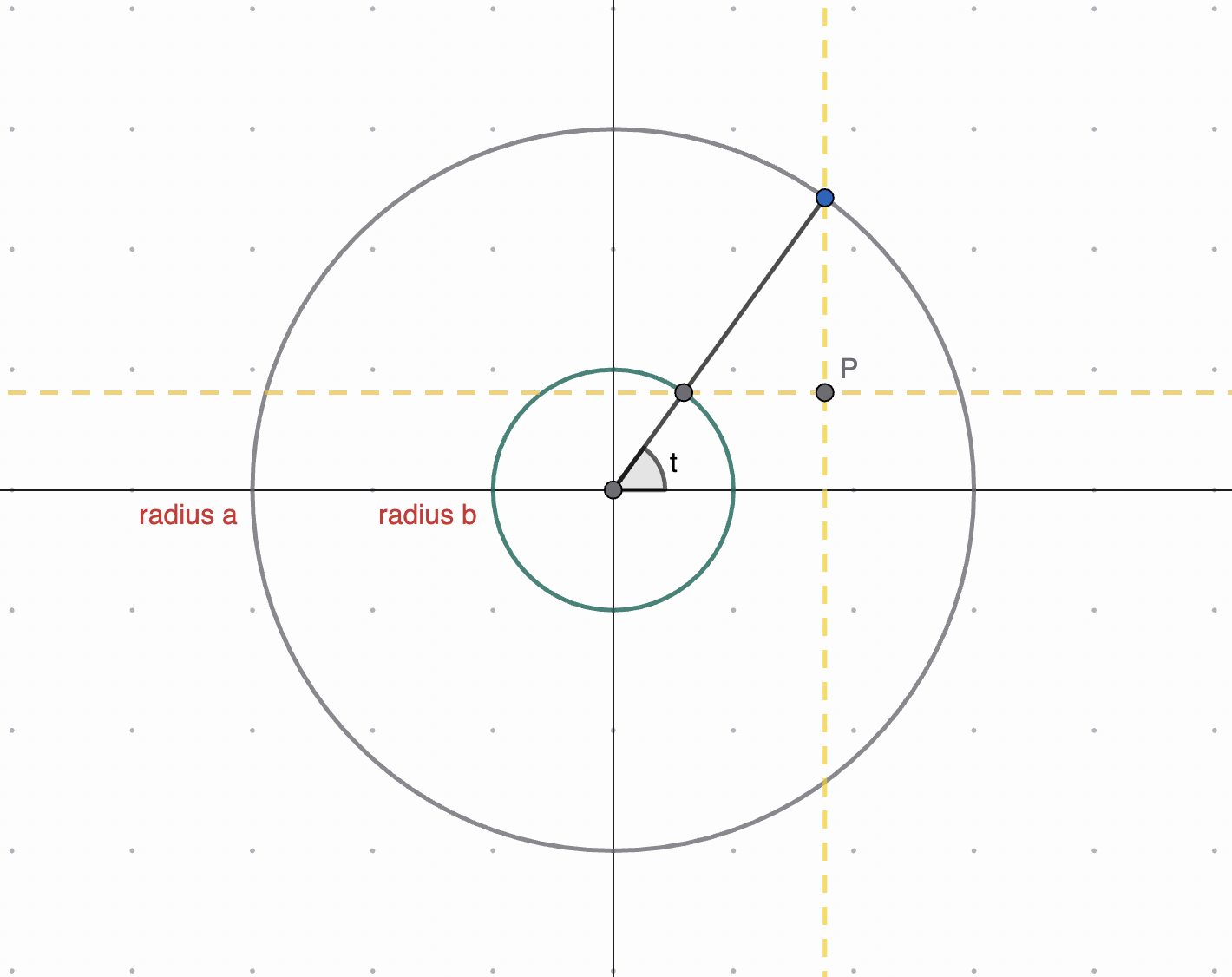
Solution. The ray at angle \(t\) meets the circle of radius \(a\) at \((a\cos t, a\sin t)\), and it meets the circle of radius \(b\) at \((b\cos t, b\sin t)\). Hence
Since \(\cos ^2 t + \sin ^2 t = 1\), eliminating \(t\) gives
which is the ellipse of Theorem 4.1 with semi-axes \(a\) and \(b\). As \(t\) runs over \([0, 2\pi ]\), \(P\) goes once around it, anticlockwise. \(\relax \vartriangleleft \)
9 The rotary engine
Theorem 9.1 (Centroid). The three medians of the triangle with vertices \((x_i, y_i)\), \(i = 1, 2, 3\), meet at the centroid
which lies two-thirds of the way along each median from its vertex.
Exercise 9.2. Show that an equilateral triangle can be inscribed in the epitrochoid
and that as the triangle moves its centroid traces a circle of radius \(b\) about the centre of the epitrochoid.
Proof. This is the principle of the rotary (Wankel) engine: a triangular rotor turns with its three tips on an epitrochoid-shaped housing, while its centre moves on a small circle.
Vertices. Fix \(t\) and take the three points of the curve at the parameters \(t_k = t + \frac {2\pi k}{3}\), for \(k = 0, 1, 2\). Since \(3t_k = 3t + 2\pi k\), the \(b\)-terms are the same for all three points: \(b\cos 3t_k = b\cos 3t\) and \(b\sin 3t_k = b\sin 3t\). Writing \(G = (b\cos 3t, b\sin 3t)\), the vertices are
Equilateral. The points \(3r(\cos t_k, \sin t_k)\) lie on the circle of radius \(3r\) about the origin, spaced \(\frac {2\pi }{3}\) apart, so they form an equilateral triangle with side \(2 \cdot 3r \sin \frac {\pi }{3} = 3\sqrt 3\,r\). Adding the fixed point \(G\) to all three is a translation, which preserves distances. So \(V_0V_1V_2\) is equilateral, and its vertices lie on the epitrochoid.
Centroid. By Theorem 9.1, the centroid is \(G + r\sum _k (\cos t_k, \sin t_k)\). By the addition formulas, with \(\cos \frac {2\pi }{3} = \cos \frac {4\pi }{3} = -\frac 12\) and \(\sin \frac {2\pi }{3} = -\sin \frac {4\pi }{3} = \frac {\sqrt 3}{2}\),
and likewise \(\sum _k \sin t_k = 0\). So the centroid is
which, as \(t\) varies, runs around the circle of radius \(b\) centred at the origin.